Contract governance is the set of rules deciding who may view, edit, approve and sign each agreement. CAMARC enforces those rules with role-based access control and single sign-on: permissions are scoped by role, department, property and owning entity, so a regional property manager sees only their assets and external parties see only their document.
The team behind CAMARC — trusted by enterprises including:










Most contract folders start with sensible permissions and drift. Someone needs temporary access for a project, gets added, and is never removed. A folder gets shared with a link so a vendor can collect one document. Two years later nobody can say with confidence who can read the portfolio’s commercial terms.
This usually goes unnoticed until it is tested — by an audit, a governance review, an owner asking whether a competitor’s manager can see their rent roll, or an employee leaving under difficult circumstances.
Access control solves this by making permission a property of the role and the asset rather than a favour granted once and forgotten. Someone joining a team inherits the right access; someone leaving loses it; and at any moment the answer to "who can see this?" is a query rather than an investigation.
Access control that matches how the business is actually organized.
Permissions attach to roles, not to individuals. Someone joining a team inherits the correct access; someone changing roles has it change with them.
Users authenticate through your existing identity provider, so account lifecycle, password policy and multi-factor requirements are governed centrally rather than per application.
Access is bounded by the assets and owning entities someone is responsible for, which is the dimension that actually matters in a portfolio business.
Vendors, brokers and counsel are granted access to one document rather than to a folder, with an expiry, and can be cut off in a single action.
The person who requests a contract cannot be its sole approver, and approval authority is enforced rather than assumed — which is what a delegated-authority policy actually requires.
Produce a current list of who can access what, by person, role, property or entity — the question every governance review opens with.
Four steps, done once, then maintained as people and portfolios change.
Single sign-on means accounts follow your existing joiner-mover-leaver process instead of being managed separately in yet another system.
Describe what a property manager, regional director, contract analyst or finance approver may do. Assign people to those roles afterwards.
Bound each assignment by the properties and owning entities that person is responsible for, so the same role means different access for different people.
Guest access, temporary elevation and delegation get expiry dates and are logged, so exceptions do not quietly become permanent.
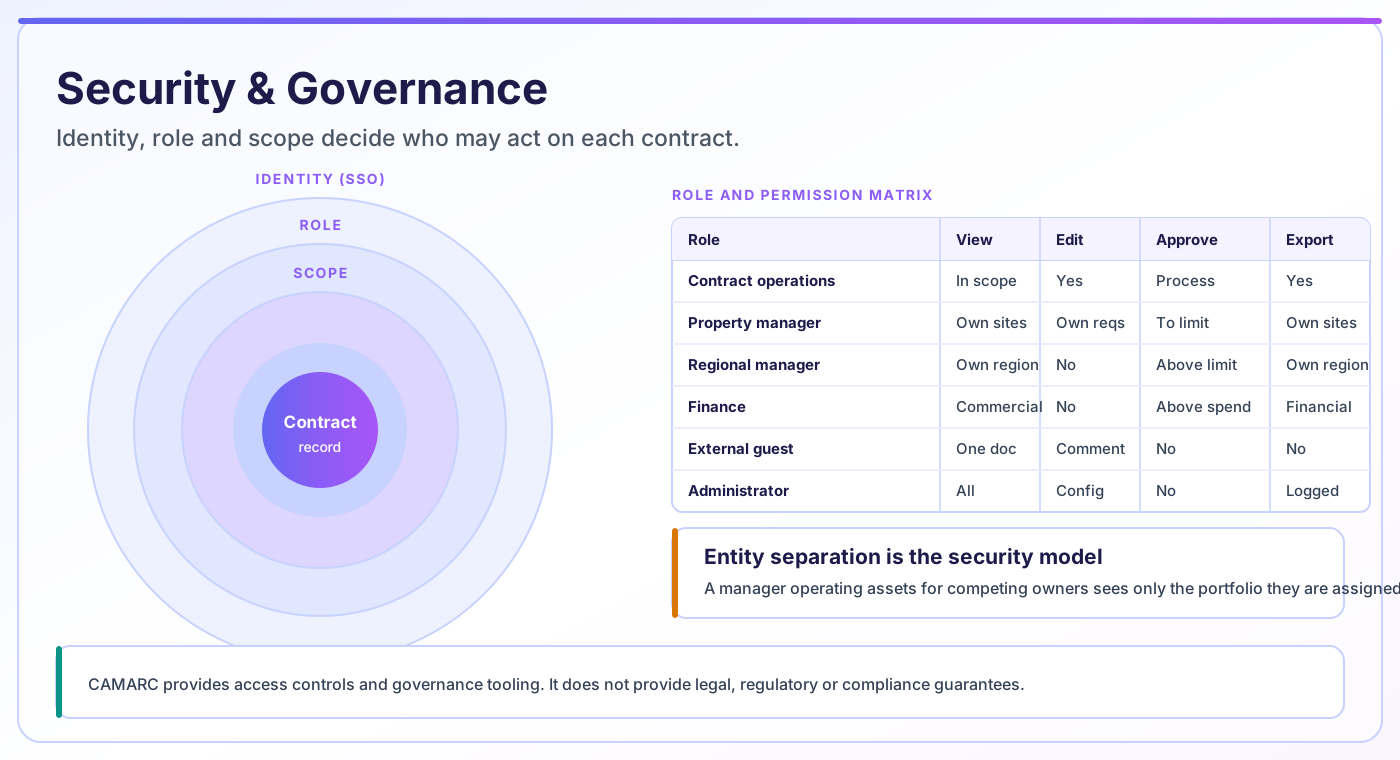
A representative starting configuration. Every one of these is adjustable — what matters is that the answer is defined rather than assumed.
| Role | View | Edit | Approve | Export |
|---|---|---|---|---|
| Contract operations | All in scope | Yes | Process only | Yes |
| Property manager | Own properties | Own requests | Within limit | Own properties |
| Regional / asset manager | Own region | No | Above property limit | Own region |
| Legal | All in scope | Yes | Legal terms | Yes |
| Finance | Commercial terms | No | Above spend threshold | Financial fields |
| Executive | Portfolio-wide | No | Escalations only | Reporting only |
| External guest | One document | Comment / propose | No | No |
| Administrator | All | Configuration | No | Yes — logged |
| Compliance administrator (exception access) | All in scope | Executed records — correction only | No | Yes — logged |
A narrow exception path exists for genuine data corrections after a contract reaches its final or executed stage — for example fixing a mis-keyed date. That access is scoped to a named administrator role, requires a stated reason, and is written to the audit trail as a distinct correction entry rather than a silent edit to history. See Lifecycle Tracking & Audit Trail for how corrections appear in the record.
CAMARC provides access controls. It does not provide legal, regulatory or compliance guarantees.
Access control is felt most by the people who never think about it.
Bring contract access under the same identity, offboarding and audit regime as everything else, rather than maintaining it as an exception.
Can answer governance questions with a report instead of an investigation, and can evidence that delegated authority was respected.
Demonstrate to each owner that their contracts are not visible to the other owners whose assets you also operate.
See a workspace scoped to their own assets, which is less overwhelming as well as more secure.
Sees commercial terms across the portfolio without needing edit rights on documents.
Get assurance that entity separation is enforced by the system rather than by convention.
Contract governance is the framework that determines how contracting decisions get made and by whom: which contract types require which approvals, what authority each role holds, which language may be varied and by whom, how exceptions are recorded, and how all of that is evidenced afterwards.
Access control is the enforcement layer. A governance policy that exists only in a document is a statement of intent; the same policy encoded as permissions and required approvals is a control. The distinction matters to auditors and it matters the first time someone is tempted to skip a step under deadline pressure.
Governance is usually owned jointly — legal defines the policy, IT enforces identity, and contract operations administers the day-to-day. Naming that ownership explicitly is worth doing before configuring anything.
Most contract compliance failures are not malicious. They are somebody working around a process that was inconvenient, using access they happened to have.
Scoped permissions reduce that risk in three concrete ways. They shrink the blast radius of any single compromised or misused account. They make the correct path the easiest one, because the workaround is no longer available. And they create a record, so the gap between what policy says and what actually happened becomes visible rather than assumed.
The corollary is worth stating plainly: over-restricting causes its own failures. If people cannot do their jobs inside the system, they will do them outside it, and you will have less visibility than before. Getting scope right is a balance, not a maximization.
Add "who should be able to see this?" to your contract-type definitions. It is far cheaper to answer at design time than during an audit.
Permissions answer who may act. Governance also needs a record of who did act, and that is a different capability — an append-only audit trail covering field changes, approvals, permission changes, signature events and exports.
The two work together. Access control prevents the wrong person from acting; the audit trail evidences that the right person did. A governance review will normally ask for both, and having one without the other tends to be where reviews get uncomfortable.
Retention and export policy belongs here too: how long records are kept, who can extract them, and in what format. Those are decisions worth making deliberately rather than inheriting from a default.
A third-party manager operates assets for three owners, two of whom compete directly in the same submarket. Each asset sits in its own single-purpose LLC. Some properties are held in joint ventures where the partners are entitled to see their own deal and nothing else.
Modelled as departments — leasing, operations, finance — this is unrepresentable. Everyone in leasing would see every lease, including the competitor’s.
Modelled by entity and property, it works. A leasing manager assigned to Owner A’s portfolio sees Owner A’s assets. A regional director spanning two owners sees both, and that overlap is an explicit, reviewable decision rather than an accident. A JV partner given portal access sees the one property they have an interest in.
This is why entity-level scoping matters more in real estate than in most industries: the ownership structure is the security model, and generic role systems do not have a place to put it.
Security questionnaires tend to cover infrastructure and miss the application-level questions that actually determine your exposure. These are the ones worth asking.
Access control constrains what can happen inside CAMARC. It does not follow a document out of the platform: once someone with legitimate access exports a contract, what happens next is governed by your policies and your endpoint controls, not by this system.
It also cannot compensate for a governance policy that has not been decided. Software will enforce whatever rules you configure, including incoherent ones. The configuration conversation is the valuable part, and it belongs to legal and the business rather than to IT alone.
CAMARC provides access controls and governance tooling. It does not provide legal, regulatory or compliance guarantees, it is not a law firm, and it is not a substitute for qualified legal counsel.
Access control decides who may act. These capabilities record what they did and what happens next.
Role-based access control assigns permissions to roles rather than to individuals. A role such as property manager or finance approver carries a defined set of view, edit, approve and export rights, and people inherit those rights by being assigned the role — so access changes automatically when someone joins, moves or leaves.
Yes. Users authenticate through your existing identity provider, which means account creation, multi-factor policy and offboarding are governed centrally. When someone is disabled in the identity provider, their access to CAMARC goes with it rather than requiring a separate step.
Yes, and this is the distinction that matters most in real estate. Permissions are scoped by property and owning entity as well as by role, so a manager responsible for one owner’s assets cannot see another owner’s contracts even though both sit in the same system and both are managed by the same team.
Contract governance is the framework determining which contracts need which approvals, what authority each role holds, and how exceptions are recorded and evidenced. It is usually owned jointly: legal defines policy, IT enforces identity, and contract operations administers it day to day. Naming that ownership before configuring anything avoids a lot of later argument.
Yes. External parties are granted guest access to a specific document rather than to a folder or a repository. That access can carry an expiry date, is recorded, and can be revoked in a single action once the negotiation concludes.
Yes. Views, changes, approvals, permission changes and exports are recorded in the audit trail, including administrator access. That record is what allows a governance review to be answered with evidence rather than with assurances.
A narrow admin role can correct a genuine error — for example a mis-keyed date — after a contract reaches its final or executed stage. That access is not available to standard roles, requires a reason for the change, and is written to the audit trail as a distinct correction entry, never as a silent overwrite of the original value.
The security and privacy considerations that matter when contract data moves into a cloud platform.
How to identify, score and control contract risk, including the governance controls that belong at each lifecycle stage.
What changes in contract management at enterprise scale, including the access and governance requirements that appear.
Bring your ownership structure. We will map roles, properties and entities into a permission model and show you the access report it produces.