Contract compliance software turns promises buried in contract text into tracked tasks with owners and due dates. CAMARC records each obligation, renewal window, notice deadline and insurance requirement, assigns it to a person, and sends escalating alerts before it comes due — so deadlines are met rather than discovered afterwards.
The team behind CAMARC — trusted by enterprises including:










A signed contract is a list of things both parties promised to do. Almost none of those promises are tracked anywhere after signature. The document goes into a folder, the deal team moves on, and the obligations exist only as text nobody re-reads.
Then a notice window closes and an unwanted contract auto-renews for another year. Or a vendor’s insurance lapses and nobody notices until an incident makes it matter. Or a reporting deliverable is missed and the counterparty has a contractual remedy.
None of these are difficult problems. They are attention problems. The obligation existed, the date was knowable, and nobody was assigned to watch it. Tracking converts an attention problem into a system problem, which is the kind software is actually good at.
The machinery that keeps post-signature commitments from quietly lapsing.
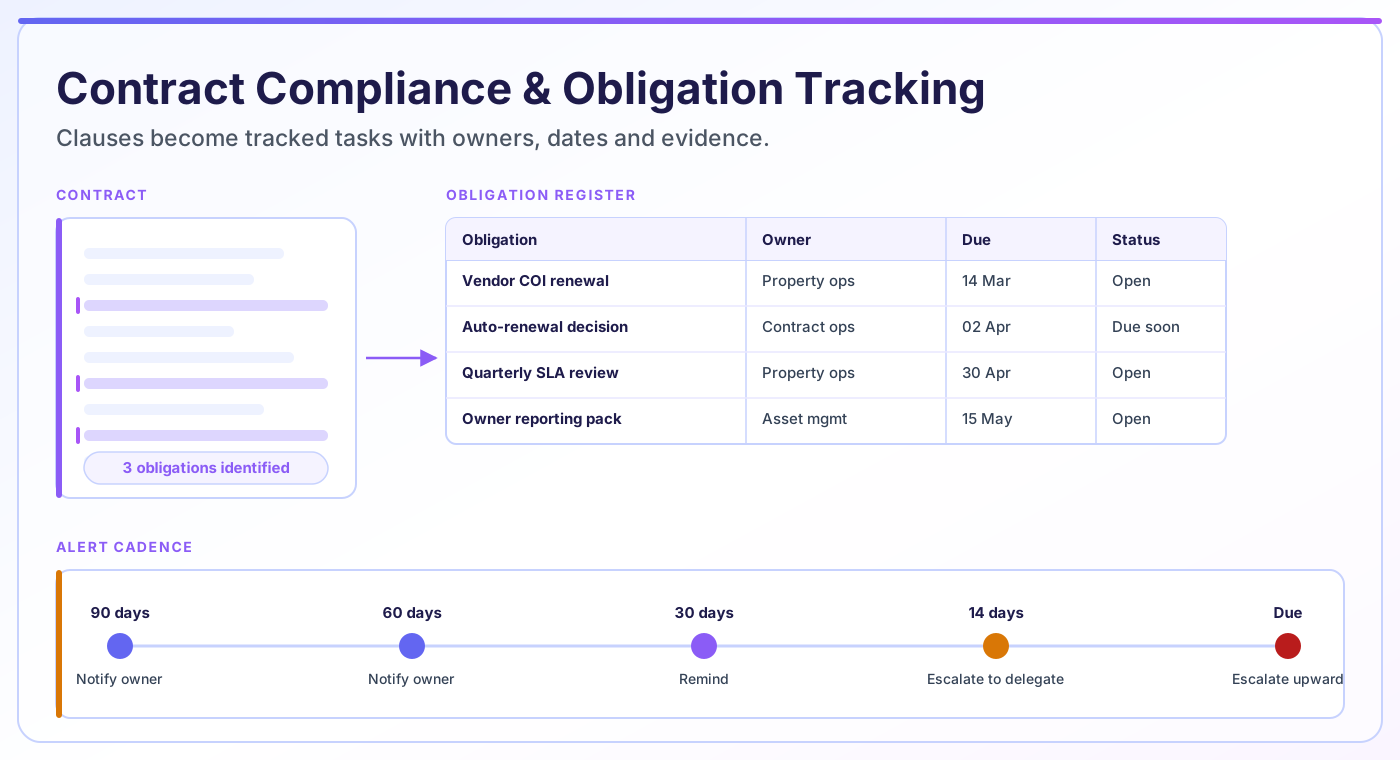
Every commitment becomes a record with a description, a named owner, a due date and a status — so obligations can be worked, reported on and closed.
Notifications fire well before a deadline and escalate as it approaches, then to a second owner if the first does not act. One unread email cannot cause a miss.
The notice window is tracked separately from the expiry date, because the date that requires action is the start of the window, not the end of the term.
Certificates and licences carry their own expiry dates on the counterparty record, so a lapse is flagged once against every property and agreement it affects.
Every obligation has one accountable person, with a delegate. An obligation without an owner is not tracked — it is just written down.
See what is due, overdue and closed, by property, entity or counterparty — the view that answers a compliance question with evidence rather than assurance.
Five steps that move a commitment out of the document and into someone’s work.
During review or at execution, the commitments that need tracking are captured — deliverables, notices, renewals, insurance requirements, reporting duties.
Each obligation gets one accountable person and a delegate. This is the step most often skipped, and skipping it makes the rest pointless.
For renewals that means the start of the notice window, not the expiry. For deliverables it means the due date, with lead time appropriate to the work.
Reminders fire on a defined cadence ahead of the date and escalate to the delegate and then upward if no action is taken.
The owner marks the obligation complete and attaches proof — the notice sent, the certificate received, the report filed — so compliance is demonstrable later.
A representative obligation taxonomy for a real estate portfolio. Lead times are starting points, not prescriptions.
| Obligation type | Example | Typical owner | Alert lead time |
|---|---|---|---|
| Auto-renewal | Service agreement renews unless cancelled | Contract operations | 120 / 90 / 60 days |
| Notice window | Lease termination notice due six months out | Leasing | 30 days before window opens |
| Insurance expiry | Vendor COI naming the owning entity | Property operations | 60 / 30 / 14 days |
| Licence and permit | Contractor licence, elevator permit | Property operations | 90 / 30 days |
| Payment and escalation | Annual rent escalation applies | Finance | 60 days |
| Service level | Quarterly SLA performance review | Property operations | 14 days before period end |
| Reporting deliverable | Owner reporting package due | Asset management | 30 / 14 days |
| Milestone | Construction completion, lien waiver | Project management | Per milestone |
CAMARC tracks obligations and deadlines. It does not interpret legal terms, determine what a clause requires, or guarantee regulatory compliance.
Obligation tracking is where contract management stops being an administrative function and starts protecting money.
Owns the obligation register and the renewal calendar, and reports on what is due, overdue and closed.
Tracks vendor insurance, licences and service-level commitments across every property they run.
Gets notice-window alerts early enough to make a decision rather than to discover one was already made by default.
Sees escalations, payment milestones and renewal-driven cost changes before they land in a budget as a surprise.
Can evidence that obligations were tracked, owned and closed, which is what a compliance review actually asks for.
Know which commitments attach to an asset before it trades, rather than discovering them during diligence.
Contract compliance software tracks whether the commitments in your agreements are actually being met. It converts obligations from contract text into monitored records with owners, dates and status, and alerts people before deadlines rather than reporting misses afterwards.
It is worth separating from two adjacent things. Regulatory compliance software tracks obligations imposed by law; contract compliance tracks obligations you agreed to. And contract management software is the broader platform — compliance tracking is the post-signature capability within it.
The value is almost entirely in the post-signature period, which is also the period most contract processes ignore. Organizations put considerable effort into getting agreements signed and then very little into whether the terms are honoured on either side.
The mechanics are simple; the discipline is the hard part. Most obligation programmes fail not because the tracking is difficult but because nobody was made accountable for individual items.
Far enough that a decision can actually be made and acted on. The common mistake is alerting thirty days before expiry on a contract with a ninety-day notice window — by then the renewal has already been triggered and the alert is just notification of a fait accompli.
A workable default is a cascade: an early alert well before the notice window opens, giving time to gather performance data and decide; a second when the window opens; a third partway through; and a final one shortly before it closes, escalated to a second owner.
The right numbers depend on the contract. A janitorial contract might need sixty days to re-tender; a major systems vendor might need six months. Set lead time from how long the replacement decision takes, not from a default.
Track the notice window as its own date. Confusing it with the expiry date is the single most common cause of an unwanted auto-renewal.
Certificate of insurance compliance across 300 vendors and 40 properties is the clearest case for obligation tracking in real estate, and one of the least well handled.
Every vendor working at every property must carry current insurance, at the required limits, naming the correct owning entity as additional insured. Certificates expire annually and on their own schedule. Handled by spreadsheet, this is accurate for roughly a week after someone updates it, and a lapsed certificate is a genuine liability exposure rather than a paperwork problem.
Tracked properly, each certificate is a record on the vendor relationship with its own expiry. Alerts fire sixty, thirty and fourteen days out to the property operations owner, escalating if the renewed certificate has not arrived. A compliance view shows every property with an expiring or lapsed certificate right now, which is a question that would otherwise take a week to answer.
The same mechanism covers contractor licences, elevator and boiler permits, and any other credential with an expiry date attached to a party working on your assets.
Obligation tracking demos easily and works poorly if a few specific things are missing.
This is the point on which it is most important to be precise. CAMARC tracks obligations that have been identified and recorded. It does not read a contract and determine what it obliges you to do — that identification is a human task, performed by people who understand the agreement.
It does not interpret legal terms, judge whether a clause has been satisfied, or determine your regulatory position. A closed obligation means someone marked it complete and attached evidence; it does not mean a lawyer has certified compliance.
Most importantly: contract compliance software does not guarantee compliance. It makes commitments visible, assigns them, and makes failures obvious rather than silent. The work still has to be done by people. CAMARC is not a law firm, does not provide legal advice, and is not a substitute for qualified legal counsel.
Obligation tracking looks forward at what is still owed. These capabilities cover the rest of the lifecycle.
Contract compliance software tracks whether the commitments in your agreements are being met. It converts obligations from contract text into monitored records with named owners, due dates and status, and alerts people before deadlines rather than reporting misses afterwards. It is distinct from regulatory compliance software, which tracks obligations imposed by law rather than ones you agreed to.
Extract obligations at execution while the deal is fresh, assign one named owner and a delegate to each, record the date that requires action, set lead times matched to the work involved, escalate automatically when nobody acts, and require evidence at closure. The mechanics are simple — the failure is almost always in not assigning individual accountability.
Renewal tracking is one type of obligation tracking. Obligations cover everything a contract commits either party to — deliverables, service levels, insurance, reporting, notices — while renewals specifically concern whether an agreement continues. Renewals get the most attention because auto-renewal has an immediate financial consequence.
One named person who can actually perform it, with a named delegate. Ownership by a team or a department means nobody is accountable, which in practice means it is not tracked. The owner should be whoever does the work, not whoever negotiated the contract.
Far enough that a decision can be made and acted on before the notice window closes. Set the lead time from how long a replacement decision actually takes — sixty days for a routine service contract, potentially six months for a major vendor. Alerting thirty days before expiry on a ninety-day notice window is too late to be useful.
No. It makes obligations visible, assigns accountability, and makes failures obvious rather than silent. The work still has to be done by people, and identifying what a contract obliges you to do remains a human task. CAMARC does not interpret legal terms, does not provide legal advice, and is not a substitute for qualified legal counsel.
How to identify, categorize and manage the deliverables and service levels a contract commits you to.
Practical approaches to tracking expirations and renewals, and the tooling that makes it reliable.
Keeping obligations, insurance and renewals under control when one vendor serves dozens of properties.
Bring one contract with real post-signature obligations. We will build its obligation register, owners and alert cadence so you can see what tracking actually looks like.