Contract lifecycle tracking records where each contract has been: requested, drafted, reviewed, approved, executed, completed. CAMARC timestamps every transition alongside a complete audit trail and version history, so you can show what changed, when it changed and who made the change — without reconstructing the story from email threads months later.
The team behind CAMARC — trusted by enterprises including:










The question always arrives late and always matters. A term turns out to be unfavourable and someone asks who agreed to it. A property is being sold and the buyer wants the contract file with evidence that approvals were followed. An auditor asks how you know that delegated spending authority was respected.
With contracts stored as files, answering means archaeology. Someone searches their inbox, finds a thread, discovers the relevant approval was given verbally in a meeting, and produces a reconstruction rather than a record. That reconstruction is worth very little in a dispute and nothing in an audit.
Recording the history as it happens costs nothing at the time and is the only way to have it when it is needed. The stage record answers where a contract has been; the audit trail answers who did what to it.
A permanent, inspectable record of a contract’s life.
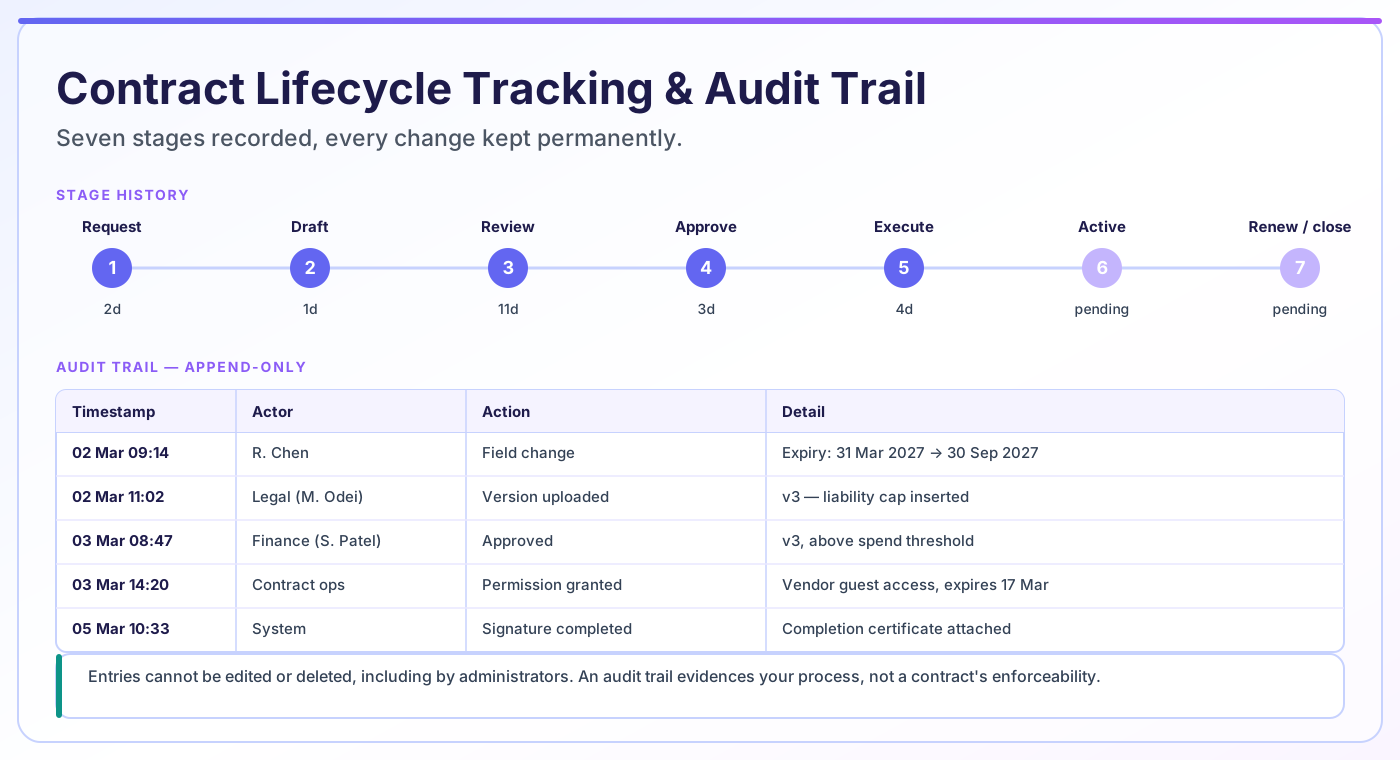
Each contract carries a current stage and a timestamped history of every transition, so status is a fact rather than an opinion.
Field changes, approvals, permission changes, signature events and exports are recorded as entries that cannot be edited or removed after the fact.
Changes record what the value was and what it became, so "the term was extended" becomes "the expiry moved from 31 March to 30 September, by this person, on this date".
Each approval records who gave it, when, in what role, and against which version of the document — which is what makes it evidence rather than an assertion.
Because transitions are timestamped, cycle time and bottlenecks are derivable from the record rather than estimated.
The full history can be exported for an auditor, a lender or a buyer, and the export itself is recorded in the log.
Seven stages, each with a timestamped entry and exit. Where a contract is, is never a matter of opinion.
The contract is requested through structured intake, with the requester and the reason recorded.
A draft is generated from an approved template, establishing the baseline version everything else is measured against.
Internal and external review rounds, each producing a version with its own attributed changes.
Required approvers act in sequence, each approval bound to the specific version in front of them.
Signature events are recorded per signer, and the executed copy is filed against the record.
The agreement is live and its obligations are tracked; amendments create new entries rather than replacing history.
The final disposition is recorded, along with who decided it and on what date.
Not everything needs logging. These are the events that get asked about, which is the useful test.
| Event | Captured detail | Why it gets asked about |
|---|---|---|
| Field change | Field, previous value, new value, actor, timestamp | Establishes when a term changed and who changed it |
| Version upload | Version number, author, timestamp | Establishes what the document said at a given moment |
| Comment | Author, text, clause reference, timestamp | Preserves the rationale behind a negotiated position |
| Approval or rejection | Approver, role, decision, version approved, timestamp | Evidences that delegated authority was respected |
| Permission change | Grantee, scope granted, granter, timestamp | Answers who could see the contract, and from when |
| Signature event | Signer, method, timestamp, completion certificate | Evidences execution and signer identity |
| Export or download | Actor, scope, timestamp | Matters when a confidentiality question is raised |
| Stage transition | From stage, to stage, actor, timestamp | Produces cycle-time data and shows where things stalled |
| Post-execution correction | Field, previous value, new value, actor, role, stated reason, timestamp | Distinguishes a deliberate, reasoned correction from an undetected change to history |
An audit trail evidences your process. It is not legal proof of a contract’s enforceability, and it does not constitute legal advice.
Rarely used day to day, and decisive on the days it is.
Evidence that approvals were obtained, in the right order, against the right version, without reconstructing anything.
Test whether delegated authority was actually respected, from a record rather than from interviews.
Produce a clean contract file with its history when an asset or a fund interest is being sold.
Use time-in-stage data to identify where the process actually stalls rather than where people think it does.
Require third-party managers to evidence that spending authority limits were observed.
Read what happened and why, instead of asking colleagues who may no longer be there.
Contract lifecycle tracking is the practice of recording which stage each agreement occupies and when it moved between stages. It answers where a contract is now, how long it has been there, and how long each earlier stage took.
It is worth separating from contract lifecycle management, which is the broader discipline of managing agreements across their whole life — drafting, negotiation, approval, execution, performance and renewal. Tracking is one capability within that discipline: the part that maintains the record.
Tracking is what turns process improvement from opinion into measurement. "Legal review is the bottleneck" is a belief until you can show that contracts sit in review for eleven days on average and in every other stage for under two.
These three get conflated constantly, and the differences matter when someone asks you to produce evidence.
Version history retains successive states of the document so you can compare or restore them. It is a working tool used during negotiation, and it answers what the contract said at a point in time. That capability belongs with collaboration and document management.
An activity feed is a convenience view — a recent-events list so you can see what has happened lately. It is usually filtered, often truncated, and not designed to be complete.
An audit trail is an evidentiary record: complete, append-only, timestamped and attributed, covering not just document changes but permissions, approvals, signatures and exports. The defining property is that entries cannot be edited or deleted after the fact. That immutability is the entire point — a log that can be altered proves nothing.
If someone can edit or delete entries, it is an activity feed, not an audit trail. Ask that question directly when evaluating any platform.
In an audit, the usual test is whether policy was followed in practice: did contracts above the threshold actually receive the required approval, from someone with authority? A complete approval log answers that directly. Without one, the answer is a sample of emails and an assurance.
In a dispute, what matters is often what each party knew and when. Comment history and version history together show what was proposed, what was accepted, and what was explicitly discussed — considerably more useful than recollection.
In a sale or a financing, the buyer or lender wants the contract file and confidence that it is complete. Producing agreements with their approval and amendment history attached shortens diligence and reduces the number of follow-up requests. This is where the value is most visible, because the alternative is measured in weeks of work.
A 40-property portfolio is being sold, and the buyer’s diligence request asks for all material service and vendor contracts, all lease amendments from the past three years, and evidence that each was properly authorized.
From a shared drive, this is a multi-week project. Documents are found, some amendments are missing, and the authorization evidence does not exist in any retrievable form — it was verbal, or in an inbox belonging to someone who has left.
From a tracked system, it is an export. Each contract carries its amendment chain, its approval record showing who approved what version and when, and its obligation register showing what remains outstanding. Scoped by owning entity, the export contains that portfolio and nothing else.
The same record answers the question institutional owners ask their third-party managers routinely: prove that the spending authority you were delegated was actually respected.
Audit trails are easy to claim and easy to implement badly. Five questions separate a real one from a log.
An audit trail records what happened inside CAMARC. Decisions made in a meeting, an approval given verbally, or a negotiation conducted by phone leave no trace unless someone records them. The trail is a faithful record of system activity, not of everything that occurred.
It also evidences your process rather than the contract’s legal standing. A complete approval record shows that your internal authority requirements were met. It does not establish that an agreement is enforceable, that its terms are adequate, or that a signature is legally valid in a given jurisdiction — those are legal questions.
CAMARC maintains records of contract activity. It does not provide legal advice and is not a substitute for review by qualified legal counsel.
The audit trail looks backward at what happened. These capabilities are what generate it.
Contract lifecycle tracking records which stage each agreement occupies and when it moved between stages — request, draft, review, approval, execution, active, and renewal or closure. It answers where a contract is now, how long it has been there, and how long each earlier stage took, which is what makes cycle time measurable.
A contract audit trail is an append-only, timestamped record of every action taken on a contract: field changes with before and after values, version uploads, approvals and rejections, permission changes, signature events and exports. Each entry records who did it and when, and entries cannot be edited or removed afterwards.
No — that is the defining property. The log is append-only, including for administrators. A record that can be altered after the fact proves nothing, so immutability is what makes it usable as evidence in an audit, a dispute or a diligence process.
Version history retains successive states of the document so you can compare or restore them during a negotiation — it answers what the contract said. An audit trail is an evidentiary record covering not just document changes but permissions, approvals, signatures and exports — it answers what happened to the contract and who did it.
Yes. The full history for a contract, or for a scoped set of contracts, can be exported for auditors, lenders or buyers. The export itself is recorded in the log, so there is a record of who extracted what and when.
Retention is a configuration decision that should be made deliberately alongside your record-keeping policy rather than inherited from a default. Because contract disputes and diligence requests can arise years after execution, retention is normally set to at least the life of the agreement plus your standard record-retention period.
The stages, process and benefits of CLM, and how the discipline fits together end to end.
Practices that hold up in real organizations, including the record-keeping habits that pay off years later.
A walkthrough of each stage from request to renewal, and what should be captured at each one.
Bring a diligence or audit request your team has had to answer manually. We will show you what the same request looks like as an export.