Contract execution management covers everything between final approval and a fully signed, filed agreement. CAMARC sends contracts for electronic signature from inside the platform, routes them to signers in the right order, shows live status for each party, and files the executed copy back onto the contract record automatically.
The team behind CAMARC — trusted by enterprises including:










Plenty of attention goes into getting a contract approved. Much less goes into what happens next, which is often where the longest delay sits. The agreement is approved on a Tuesday, someone has to export it, prepare signature blocks, work out who signs in what order, send it, and then chase.
That chasing is invisible work and it is nobody’s actual job. Meanwhile the counterparty is waiting, the vendor may already have started work, and the contract that everyone agreed to two weeks ago still is not in force.
The gap closes when execution is part of the workflow rather than a separate task performed in a separate tool. Approval hands directly to signature, signature status is visible without asking, and the executed document returns to the record on its own.
Execution as a step in the workflow rather than an errand after it.
Signature requests go out from the approved contract itself. No exporting, no re-uploading, no risk of sending a version that is not the approved one.
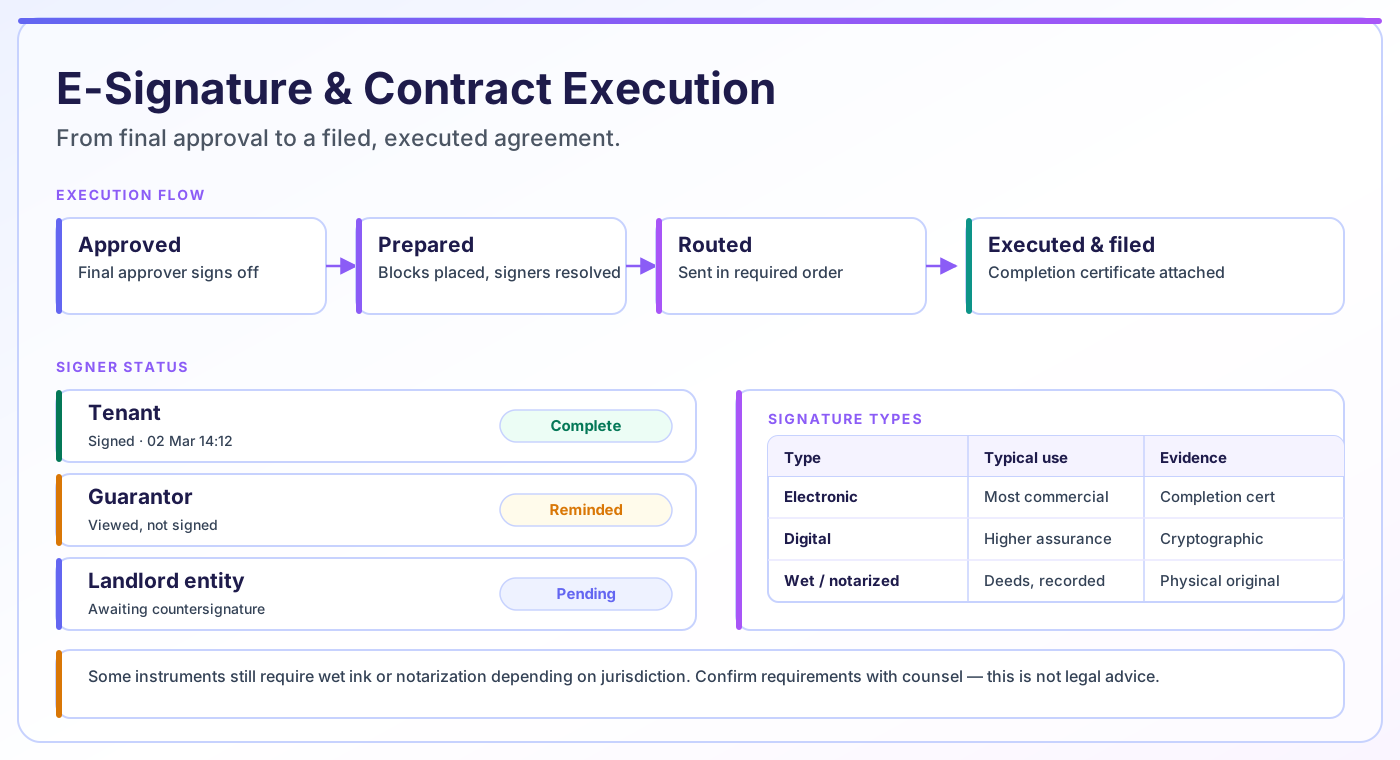
Signers sign in a defined sequence where order matters — tenant, then landlord entity, then guarantor — or in parallel where it does not.
See who has been sent it, who has opened it and who has signed, so chasing is targeted rather than a blanket follow-up to everyone.
Outstanding signers are reminded on a schedule without anyone having to remember, and the internal owner is notified if it stalls.
Execution produces an audit record of each signature — identity, method and timestamp — retained with the executed document.
The executed copy is filed on the contract record, and the obligations and key dates captured at intake switch from pending to actively tracked.
Six steps from final approval to an active, filed agreement.
The last required approver signs off, and the contract moves to execution automatically rather than waiting for someone to notice.
Signature blocks and fields are placed, and the signing parties are resolved — including the correct authorized signatory for the owning entity.
The request goes to signers in the required order, or in parallel where order does not matter, with a chosen reviewer track, a response-by date, a hard deadline, and a message that provides context.
Status is visible per signer and reminders fire automatically. Whoever owns the contract can see exactly where it is stuck.
Internal signatories complete the chain, with the correct entity signatory enforced rather than assumed.
The executed document and its completion certificate are filed on the record, and obligation tracking begins.
These terms get used interchangeably and are not the same thing. The differences matter when a document has formality requirements.
| Type | How it works | Typical use | Evidence produced |
|---|---|---|---|
| Electronic signature | Intent to sign captured electronically, with identity and audit data | The large majority of commercial agreements | Completion certificate: identity, method, timestamp, IP |
| Digital signature | Cryptographic signature bound to a certificate | Higher-assurance or regulated contexts | Cryptographic proof of signer and document integrity |
| Wet signature | Physical ink on paper | Instruments with formality requirements | The original physical document |
| Notarized | Wet or electronic signature witnessed by a notary | Deeds and certain recorded instruments | Notarial certificate |
Which type a given document requires depends on the instrument and the jurisdiction. That is a legal question — confirm it with counsel rather than assuming an electronic signature is always sufficient.
Execution touches the people who currently do the chasing.
Stops manually preparing, sending and chasing signature requests, and stops filing executed copies by hand.
Gets amendments signed across tenant, landlord entity and guarantor without coordinating the order by email.
Gets vendors under contract before work begins rather than shortly after.
Knows the version sent for signature is the version that was approved, because it comes from the record rather than from a desktop.
Sees agreements become effective on a known date, with payment obligations activating at the same moment.
Sign from a browser without creating an account or installing anything, which removes the most common source of delay.
In the United States, electronic signatures are given legal effect by the federal ESIGN Act (2000) and, at state level, by the Uniform Electronic Transactions Act, which most states have adopted. The general position under those statutes is that a signature or contract may not be denied legal effect solely because it is in electronic form.
There are exceptions. Both ESIGN and UETA carve out certain categories, and some instruments carry additional formality requirements — deeds, documents that must be recorded, and anything requiring notarization or witnessing. Requirements also vary by state and by document type.
The practical approach is to establish with counsel which of your contract types can be executed electronically and which cannot, record that decision against each contract type, and let the workflow follow it. That is a one-time legal conversation that then runs automatically.
This is a general description of the statutory position, not legal advice. CAMARC does not provide legal advice and makes no compliance guarantee — confirm requirements for your document types and jurisdictions with qualified counsel.
Signer order matters more than it first appears. Where a guarantor signs conditional on the principal, or where a landlord countersigns after a tenant, signing out of order can create genuine problems. Sequential routing enforces the order rather than relying on everyone reading the covering email.
Entity signatories are the harder part in real estate. The signing party is frequently an LLC with a specific authorized signatory, and that authority sits in the operating agreement rather than in an org chart. Getting it wrong produces a document signed by someone without authority to bind the entity.
Because CAMARC holds the owning entity as structured data, the correct signatory for that entity can be resolved automatically rather than looked up per contract. Delegation is handled explicitly, with the delegation recorded rather than assumed.
Before a request goes out, the sender can also choose a reviewer track — for example a countersigning review, or straight to signature — and set two dates per request: a response-by date that triggers a reminder, and a hard deadline after which the request is flagged overdue and escalated. Both dates are visible to everyone on the signing chain, not only to the sender.
A lease amendment requires three signatures: the tenant, the landlord entity that owns the asset, and a corporate guarantor standing behind the tenant. Handled manually, someone works out who signs first, prepares the document, emails it to three parties, and then spends a fortnight following up.
Routed properly, the tenant signs first, the guarantor signs on the tenant’s execution, and the landlord entity’s authorized signatory countersigns to complete. Each party is reminded automatically. The leasing manager can see that the tenant signed on Tuesday and the guarantor has opened but not signed, so the chase is directed at one party rather than all three.
On completion, the executed amendment is filed on the lease record with its completion certificate, and the revised dates it introduced — new expiry, new option deadline, revised escalation — become tracked obligations immediately rather than after someone remembers to update them.
If you are comparing execution capability inside a CLM against a standalone e-signature product, these are the differences that actually show up in use.
Electronic signature does not cover every instrument. Deeds, certain recorded documents, and anything requiring notarization or witnessing may still need wet ink or additional formality depending on jurisdiction — which in commercial real estate is a live constraint rather than a theoretical one. Identify those contract types up front and route them differently.
Execution also cannot compress the part of the delay that is a counterparty not signing. It removes the preparation time, the coordination overhead and the guesswork about who is holding it, which is usually most of the delay — but not all of it.
CAMARC supports contract execution. It does not provide legal advice, does not determine whether an electronic signature is valid for a given instrument in a given jurisdiction, and is not a substitute for qualified legal counsel.
Execution is the handoff from agreement to obligation. These capabilities are on either side of it.
Contract execution management covers everything between final approval and a fully signed, filed agreement: preparing signature blocks, resolving who signs and in what order, sending the request, tracking and chasing signers, capturing the completion record, and filing the executed copy back onto the contract record.
From the contract record itself, once final approval is complete. Signature blocks are placed, signers are resolved — including the authorized signatory for the owning entity — and the request routes in the required order. There is no export and re-upload step, so the version sent is provably the version that was approved.
In the United States, the federal ESIGN Act and state adoptions of UETA generally give electronic signatures legal effect, meaning a contract is not denied validity solely because it was signed electronically. Exceptions exist, and some instruments — deeds, recorded documents, anything requiring notarization — carry additional requirements. This is a general description rather than legal advice; confirm your document types with counsel.
An electronic signature captures intent to sign electronically, along with identity and audit data such as timestamp and method. A digital signature is a specific cryptographic technique that binds a signature to a certificate and proves the document has not been altered. Most commercial agreements use electronic signatures; digital signatures appear in higher-assurance and regulated contexts.
Yes. Sequential routing enforces the order where it matters — for example a tenant, then a guarantor, then the landlord entity countersigning — and parallel routing is available where order is irrelevant. Enforcing the order in the system avoids relying on everyone reading the covering email.
On the contract record in CAMARC, alongside its negotiation history and completion certificate. Filing is automatic, and execution also activates the obligations and key dates captured at intake, so the agreement starts being tracked at the moment it becomes effective rather than when someone updates a spreadsheet.
Yes. Choose a reviewer track — for example a countersigning review versus straight to signature — and set two dates: a response-by date that triggers a reminder, and a hard deadline that flags the request as overdue and escalates it to the internal owner.
How electronic signature changes execution timelines, and the compliance considerations that come with it.
Where execution sits in the wider process, and what should be captured as a contract becomes effective.
How digital transaction tools speed up real estate deals, and where they fit alongside contract management.
Bring a contract type with a multi-party signature chain. We will route it end to end so you can see the execution step running inside the workflow.