CAMARC ships with the contract types commercial real estate teams actually use — lease amendments and renewals, vendor and service agreements, brokerage agreements, NDAs and purchase documents — each with its own template, required fields and approval route. Teams configure their portfolio structure instead of designing a contract system from an empty page.
The team behind CAMARC — trusted by enterprises including:










Horizontal contract platforms model an organization as departments and contracts as a handful of generic types — an MSA, an NDA, a purchase order. That works for a software company. It does not describe a business where the same vendor contracts separately with a dozen owning entities, where a lease amendment has a notice window measured in months, and where approval authority depends on which asset the contract touches.
The result is that CRE teams spend their first two months of any implementation building the model rather than using the product: defining contract types, working out where property and entity belong, and discovering that the permission system has no place to put ownership structure.
Shipping with the contract types and portfolio structure already modelled removes that phase. The configuration conversation becomes "here is our portfolio and our approval thresholds" rather than "here is how commercial real estate works".
The contract types, fields and structures that a CRE team needs on day one.
Amendments, renewals, extensions and estoppels, with commencement, expiry, escalation, notice window and option dates as structured fields rather than prose.
Master services agreements, maintenance and service contracts, and purchase orders, with insurance requirements and auto-renewal terms captured as tracked data.
Listing agreements, commission agreements, letters of intent and purchase-and-sale documents, routed to the approvers those transactions actually require.
Contractor agreements, change orders and TI documents, with milestone and lien-waiver dates tracked alongside the contract value.
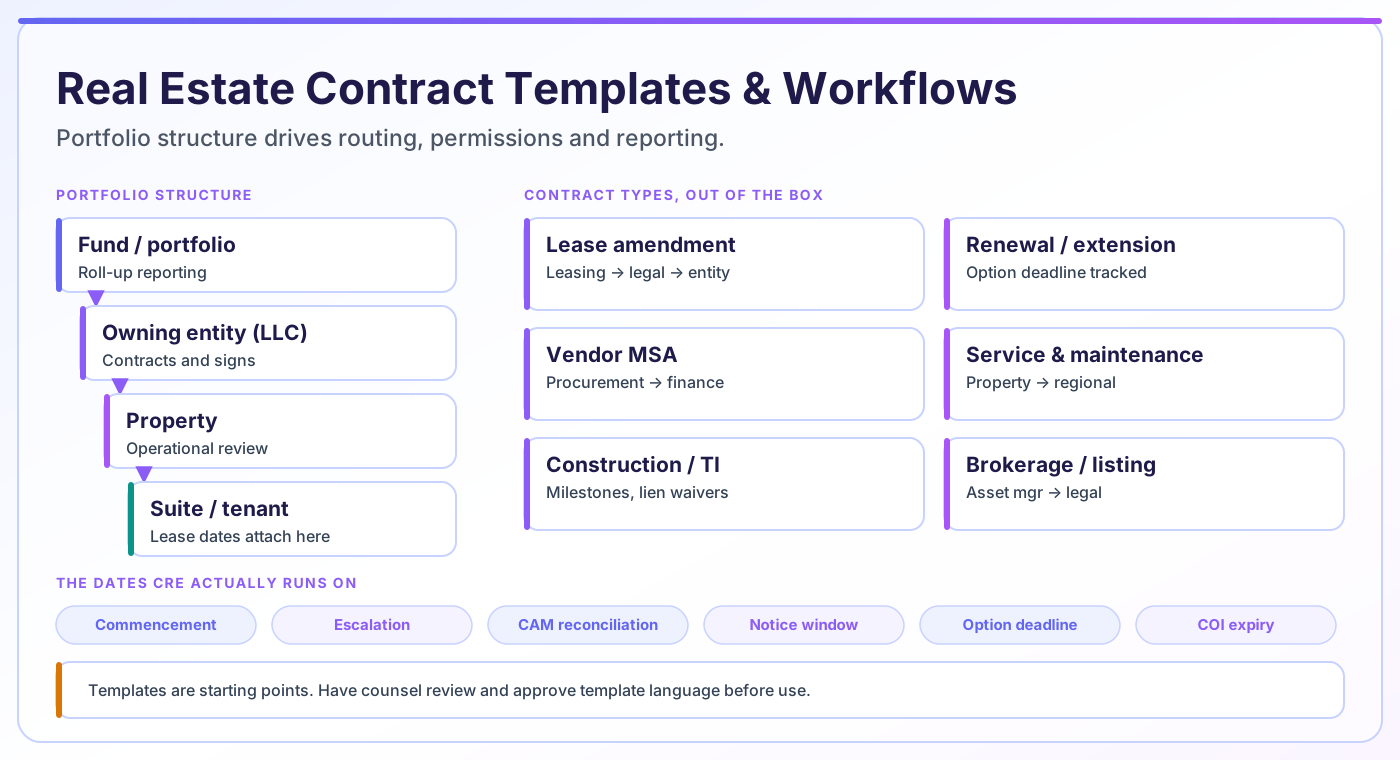
Fund, owning entity, property and suite exist as first-class structure, which is what makes routing, permissions and reporting work correctly without workarounds.
Counsel-approved language and agreed fallback positions are stored once and reused, so drafting starts from what legal already signed off on.
Four levels of structure, each doing real work in routing, permissions and reporting.
The top-level grouping used for roll-up reporting and for scoping the access of executives and asset managers.
The legal entity that actually contracts and signs. This determines the authorized signatory and enforces separation between owners.
The asset a contract touches. Drives who reviews it operationally and which site team can see it.
For lease documents, the specific space and counterparty — where commencement, expiry and option dates attach.
Every type carries different key dates and different approvers. This is the model CAMARC starts from, and it is adjustable.
| Contract type | Typical owner | Key dates and fields | Typical approvers |
|---|---|---|---|
| Lease amendment | Leasing | Effective date, revised term, rent change | Leasing manager, legal, entity signatory |
| Lease renewal / extension | Leasing | Option deadline, notice window, new expiry | Leasing manager, asset manager, entity signatory |
| Vendor MSA | Procurement | Term, auto-renewal, insurance requirement | Procurement, legal, finance above threshold |
| Service & maintenance | Property operations | Scope, term, renewal date, COI expiry | Property manager, regional above threshold |
| Construction / TI | Construction | Milestones, retainage, lien waiver dates | Project manager, finance, legal |
| Brokerage / listing | Leasing or investments | Term, commission basis, exclusivity period | Asset manager, legal, entity signatory |
| NDA / LOI | Investments | Term, expiry, exclusivity | Legal (often the only approver) |
| Purchase & sale documents | Investments | Diligence deadlines, closing date, deposits | Investment committee, legal, entity signatory |
Templates are a starting point. Have counsel review and approve template language before it is used — CAMARC does not provide legal advice.
Contract types map fairly cleanly onto the teams that own them.
Raise amendments and renewals from the correct form, with option deadlines and notice windows captured as tracked dates rather than diary entries.
Handle service and maintenance agreements at the property level, with insurance requirements attached to the vendor rather than to a spreadsheet.
Track contractor agreements and change orders with milestone and lien-waiver dates alongside the contract value.
Move NDAs and LOIs quickly on a short route, while purchase documents follow a longer, committee-level path.
Maintains the clause library once, and sees deviations from approved language flagged rather than having to spot them.
Reports by fund, owning entity and property because those are structural fields, not conventions in a filename.
They are adjacent and often confused. Lease administration is the post-execution discipline: abstracting the lease, billing rent, reconciling CAM, tracking escalations and options, and keeping the rent roll accurate. It runs for the life of the tenancy.
Lease contract management is the process of getting the document agreed and executed in the first place: drafting the amendment, routing it for review, negotiating with tenant counsel, capturing approvals and executing it correctly against the right entity.
Most organizations need both, and the handoff between them is where data is usually lost — a lease is executed in one system and re-keyed into another, with the abstraction quality depending on whoever did the typing. Capturing key dates as structured data at execution reduces that loss considerably.
If you are evaluating tools, be clear which problem you are solving. A lease administration system will not manage a negotiation, and a contract platform will not reconcile CAM.
A clause library is only useful if it reflects positions counsel has actually agreed, including the fallbacks. A library of preferred language with no fallback positions gets abandoned the first time a counterparty pushes back.
A property management firm takes on a 40-property portfolio held across twelve owner entities and needs contracting live in weeks, not quarters.
The first week is spent on structure rather than software design: loading the fund, entity, property and suite hierarchy, and setting spending thresholds per role. The three highest-volume contract types — service agreements, lease amendments and vendor MSAs — already exist as templates with their fields and routes defined.
By the end of week one, a property manager can raise a service agreement request against a specific property, have it route to the correct regional approver above the threshold, and reach the correct entity signatory. The remaining contract types are added over the following weeks without blocking anything.
The alternative — modelling contract types from scratch before the first request can be raised — is what turns a CLM rollout into a two-quarter project.
When evaluating any platform for a real estate portfolio, these are the questions that separate a genuine fit from a demo that looked fine.
For a buyer’s guide to the category rather than to this product, see our guide to contract management software for real estate.
Templates are starting points, not finished documents. Every template should be reviewed and approved by your own counsel before use, and jurisdiction-specific requirements will need attention that no default template can anticipate.
CAMARC also does not perform lease administration. It manages the contracting process and captures structured data at execution; rent billing, CAM reconciliation and rent-roll maintenance remain the domain of a lease administration system, though the data captured here makes that handoff cleaner.
CAMARC supports contract operations for real estate teams. It does not provide legal advice and is not a substitute for review by qualified legal counsel.
Templates define what a contract type is. These capabilities move it through its life.
Yes. Lease amendments, renewals and extensions, vendor and service agreements, brokerage and listing agreements, NDAs and letters of intent, construction and tenant-improvement documents, and purchase-and-sale documents ship pre-modelled, each with its own required fields, key dates and approval route.
Lease administration is post-execution: abstracting the lease, billing rent, reconciling CAM and tracking escalations. Lease contract management is getting the document agreed and executed — drafting, routing, negotiating and approving it. Most teams need both, and the handoff between them is where data is usually lost.
Yes. The shipped templates are a starting point. Your own approved language and fallback positions can be loaded into the clause library, and it is expected that your counsel reviews and approves anything before it goes into use.
Yes, and in real estate they usually must. Property and owning entity are first-class structure in CAMARC, so approval routing, permissions and reporting can all key off them — meaning the same contract type can follow a different, correct path depending on which asset and which entity it concerns.
Leasing documents, vendor and service agreements, construction and tenant-improvement contracts, brokerage and listing agreements, NDAs and LOIs, and purchase-and-sale documents. Additional types can be configured, since a contract type is a template plus its fields and its route.
No. Templates reduce how often legal review is needed for routine agreements by starting from language counsel has already approved, and they make deviations visible. They do not remove the need for legal review of non-standard terms, and CAMARC does not provide legal advice.
A buyer-side guide to the category: what real estate teams should look for and how it differs from generic CLM.
Where lease administration ends and contract lifecycle management begins, and how to make the handoff clean.
Keeping obligations, insurance and renewals under control when the same vendor serves dozens of properties.
Bring your entity and property structure and the two contract types you handle most. We will have them routing correctly inside the session.