Smart Contracts vs. Traditional Contracts: A Business Guide
Contracts are the foundation of business relationships, but how agreements are created, executed, and enforced is changing. Traditional contracts still dominate, while blockchain smart contracts are gaining attention for automating transactions and improving transparency.
For enterprise teams, the question is not replacement. It is whether smart contracts create value in the right use cases while fitting governance, approvals, auditability, and risk control.
CAMARC helps organizations modernize contract operations with workflow automation, compliance, and lifecycle visibility. This guide explains smart contracts vs. traditional contracts, where each fits, and how to evaluate smart contracts responsibly.
TL;DR: Smart contracts are blockchain-based code that can automatically execute rules when conditions are met. Traditional contracts are legal text agreements enforced through people, processes, and courts. Most enterprises benefit from a hybrid model: smart contracts for execution logic, CLM for lifecycle governance and control.
Want better visibility into contract approvals, obligations, and risk across your organization? See how CAMARC modernizes contract operations with structured workflows and governance.
Explore CAMARCWhat Are Smart Contracts?
A smart contract is software deployed on a blockchain that automatically executes predefined actions when specified conditions are met.
Smart contracts are digital agreements stored and executed on a blockchain. They follow simple "if/when this happens, then do that" logic to trigger actions such as releasing payment, updating ownership, or moving a workflow forward once inputs are verified.
Most smart contract discussions focus on Ethereum, but other platforms exist. Bitcoin supports more limited scripting and is generally less flexible for complex business automation. Ethereum smart contracts enable broader programmable logic, which is why they are more commonly used in enterprise and DeFi contexts.
Smart contract development translates business rules into code. Instead of relying mainly on legal interpretation after the fact, the contract enforces defined logic at execution time. This is the core property that makes smart contracts attractive for structured, measurable workflows.
References: AI in Contract Management, Benefits of Contract Lifecycle Management Software
What Are Traditional Contracts?
A traditional contract is a written legal agreement that sets obligations and remedies and is enforced through legal and business processes.
Traditional contracts are legally enforceable agreements written in natural language and signed by the parties involved. They define obligations, rights, timelines, payment terms, liability, dispute handling, and remedies if one party does not perform as promised.
Their biggest strength is flexibility. Traditional contracts can handle ambiguity, negotiation, exceptions, and evolving business realities in a way code often cannot. They are also supported by well-established legal systems, which makes them more practical for many complex business relationships.
In enterprise settings, traditional contracts are often supported by CLM platforms that centralize records, route approvals, and track obligations. The agreement stays text-based, while the surrounding process becomes faster and more controlled. CAMARC is one example of CLM built to improve how agreements are requested, reviewed, approved, executed, monitored, and renewed across the organization.
References: What Is Contract Lifecycle Management (CLM)?, CAMARC homepage
Smart Contracts vs. Traditional Contracts: Key Differences
The difference is not just digital versus paper. It is how terms are expressed, executed, enforced, and managed over time. Smart contracts work best where terms are objective and measurable. Traditional contracts work best where interpretation, negotiation, and legal nuance matter.
In practice, organizations should not think in absolute terms. The more realistic model is selective automation: use smart contracts for highly structured transactional logic, while using traditional contracts and CLM platforms to manage the broader business relationship.
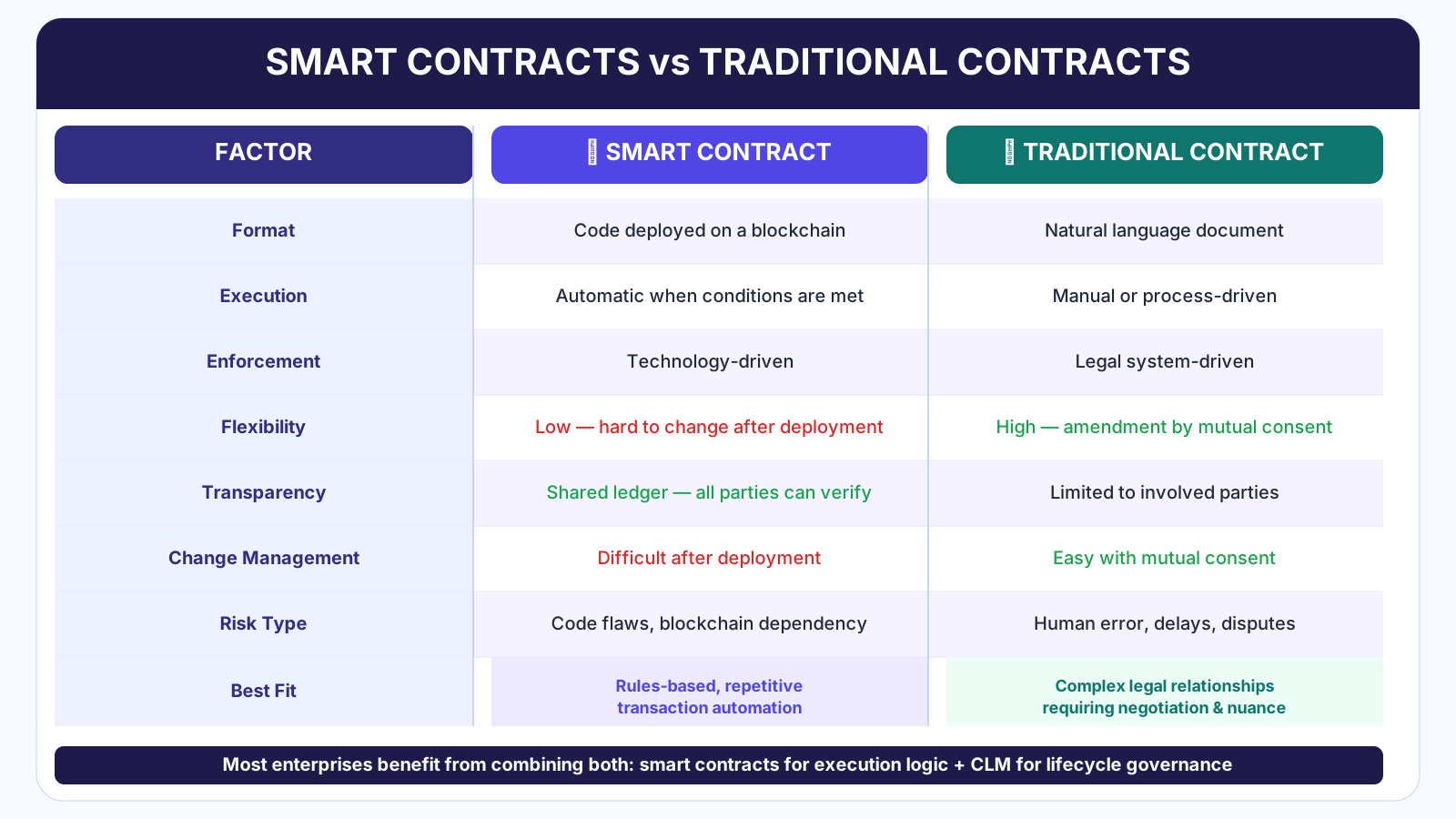
| Factor | Smart Contracts | Traditional Contracts |
|---|---|---|
| Format | Code on a blockchain | Natural language document |
| Execution | Automatic when conditions are met | Manual or process-driven |
| Enforcement | Technology-driven | Legal system-driven |
| Flexibility | Low after deployment | High through amendment and interpretation |
| Transparency | Often shared ledger visibility | Limited to involved parties |
| Change Management | Difficult after deployment | Easier with mutual consent |
| Risk Type | Code flaws and blockchain dependencies | Human error, delays, disputes |
| Best Fit | Rules-based automation | Complex legal relationships |
References: Contract Management vs Contract Lifecycle Management, CAMARC homepage
Benefits of Smart Contracts
Smart contract benefits come mainly from automation and consistency. When implemented correctly, they reduce manual handoffs, speed execution, and improve traceability. These advantages explain why smart contracts in business are often discussed in areas like supply chain coordination, digital payments, settlement logic, compliance triggers, and tokenized asset workflows.
Key benefits of smart contracts include:
- Faster execution because actions occur automatically once conditions are verified
- Lower dependency on intermediaries in selected transaction models
- Better consistency because the same logic is applied every time
- Stronger transparency through shared blockchain records
- Reduced administrative effort in repetitive transactional workflows
- Better auditability for events recorded on-chain
These benefits depend on fit. If a process is dispute-prone, highly conditional, or requires subjective judgment, automation value may be limited. The upfront investment in smart contract development, auditing, and integration also needs to be weighed against the operational gains for each specific use case.
References: Benefits of Contract Lifecycle Management Software, Best Contract Lifecycle Management Software
Risks, Security, and Smart Contract Auditing
Security is the biggest adoption risk for organizations exploring smart contracts in business. Smart contract vulnerabilities can cause financial loss, operational disruption, and legal uncertainty. If code is flawed, it may execute incorrectly while still behaving "as programmed." There is no undo button once an on-chain transaction has been triggered.
That is why smart contract auditing is not optional for serious business use. Before deployment, organizations should conduct:
- Smart contract security audit reviews by qualified external parties
- Code testing for edge cases and failure conditions
- Architecture validation for external data dependencies (oracles)
- Governance reviews for upgrade, rollback, and access control design
- Legal review to confirm the smart contract aligns with the underlying agreement
Many enterprises engage external audit services that specialize in finding logic flaws, unsafe assumptions, access control issues, and dependency weaknesses before launch. Security also extends to identity management, data inputs, and third-party integrations. Every external dependency in a smart contract is a potential attack surface.
| Risk category | Description | Mitigation |
|---|---|---|
| Code vulnerabilities | Logic flaws that cause incorrect execution | Pre-deployment security audit |
| Oracle risk | Bad external data triggers wrong outcome | Verified, redundant data sources |
| Immutability risk | Flawed code cannot easily be corrected post-deployment | Upgrade pattern architecture and testing |
| Legal uncertainty | On-chain execution may not align with legal intent | Legal review alongside code review |
| Governance gaps | No clear ownership for fixes, updates, or disputes | Defined roles, rollback policies, and access controls |
References: AI in Contract Management, CAMARC homepage
Exploring advanced contract automation but concerned about governance and risk? Contact CAMARC to discuss the right contract operating model for your organization.
Contact UsSmart Contract Applications in Business
What are smart contracts used for in practice? The most promising smart contract applications are usually processes with clear conditions, predictable triggers, and measurable outputs. When those conditions are present, the automation value is highest and the governance complexity is most manageable.
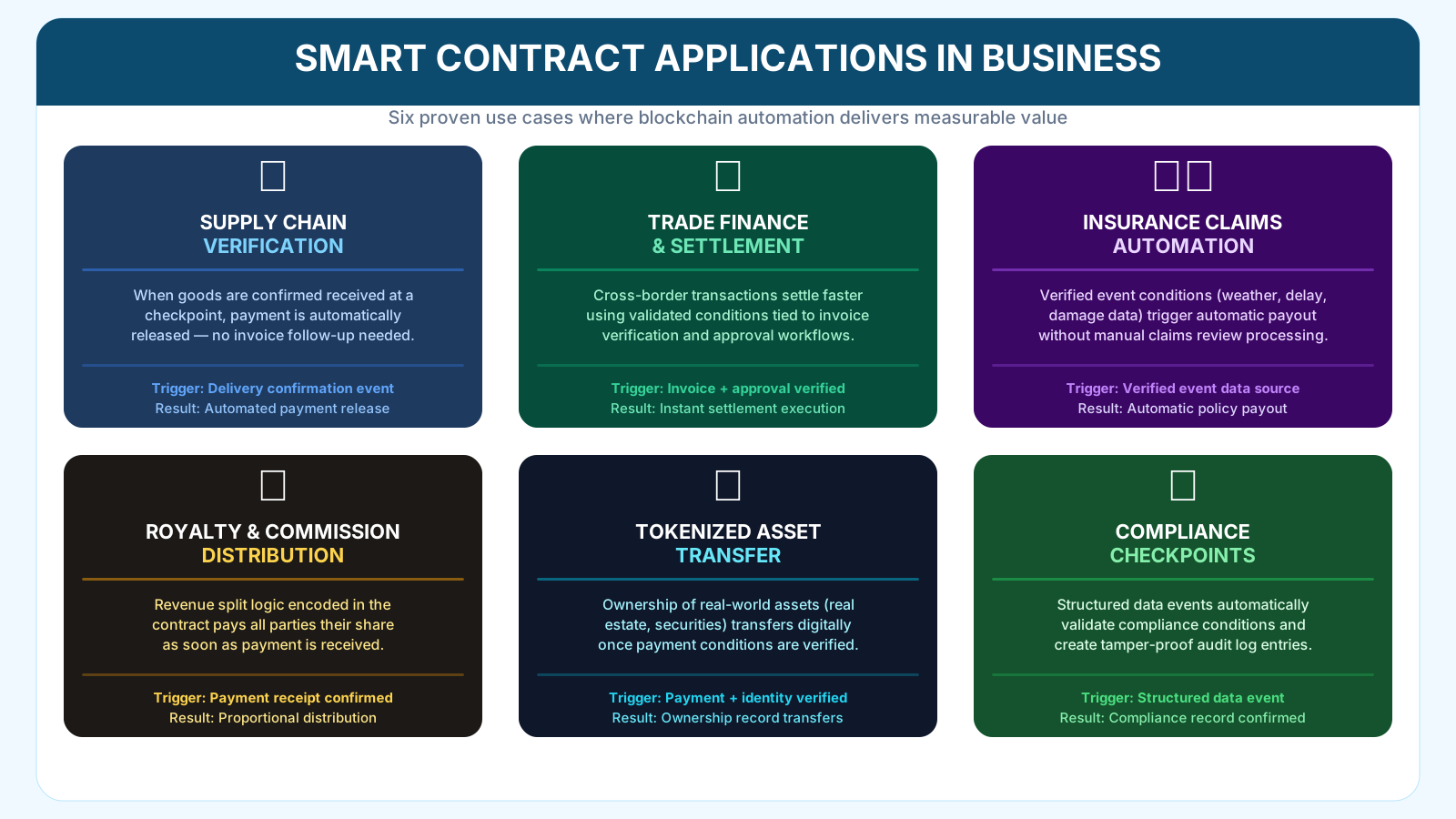
Common applications of smart contracts in business include:
Supply Chain Handoff Verification
When goods are confirmed received at a checkpoint, payment is automatically released without invoice follow-up. The trigger is a verified delivery event. The result is automated payment release tied directly to the physical handoff.
Trade Finance and Settlement
Cross-border transactions can settle faster using validated conditions tied to invoice verification and approval workflows. Smart contracts reduce the time and manual effort involved in trade finance by automating the settlement step once all pre-conditions are met.
Insurance Claims Automation
Verified event conditions such as specific weather data, confirmed delays, or validated damage assessments trigger automatic payouts without manual claims review. This is particularly effective for parametric insurance products with clear, measurable payout conditions.
Royalty and Commission Distribution
Revenue split logic encoded in the contract pays all parties their defined share as soon as payment is received. This eliminates manual calculation, reduces disputes, and ensures consistent enforcement of royalty and commission terms.
Tokenized Asset Transfer
Ownership of real-world assets such as real estate, securities, or intellectual property rights transfers digitally once payment and identity conditions are verified on-chain. This reduces settlement time and counterparty risk in asset transfer transactions.
Compliance Checkpoints
Structured data events automatically validate compliance conditions and create tamper-proof audit log entries. This is useful in regulatory workflows where specific data-verified milestones must be recorded for compliance documentation.
These use cases often still need enterprise support. A blockchain event may trigger payment, but teams still need reporting, approvals, audit trails, and a central contract repository. That is why businesses should evaluate smart contracts as part of a wider contract operations strategy rather than as isolated blockchain experiments.
References: What Is Contract Lifecycle Management (CLM)?, AI in Contract Management
How to Evaluate Smart Contracts for Enterprise Use
Do not start development without a structured evaluation. A controlled, business-first approach is more effective and reduces the risk of over-engineering solutions for problems that do not require blockchain automation.
Step 1: Identify the right use case
Choose a process with clear conditions, measurable outcomes, and repetitive logic. If terms are highly subjective, negotiated, or exception-heavy, traditional contracts supported by CLM may still be the better fit. The best candidates for smart contracts have unambiguous triggers and well-defined outputs.
Step 2: Define what should remain off-chain
Not everything belongs in blockchain logic. Decide what should be automated in code and what should remain under standard legal and operational control. Complex negotiations, relationship management, and exception handling are typically better managed outside the smart contract layer.
Step 3: Assess platform and integration needs
Evaluate smart contract platforms based on scalability, security, privacy, governance capabilities, and compatibility with your existing enterprise systems. Consider whether Ethereum smart contracts or other platforms better match your technical and regulatory requirements.
Step 4: Plan for security from the beginning
Build smart contract auditing, review cycles, and testing into the delivery model from the start. Security should not be a final-stage activity. Identify which external audit partners and testing frameworks you will use before writing production code.
Step 5: Connect execution to contract operations
If a smart contract triggers a payment or milestone completion, that activity should still be reflected in your broader contract lifecycle process. This is where CLM platforms provide value by maintaining visibility, compliance documentation, and governance records even for on-chain events.
Step 6: Pilot before scaling
Start with a limited, lower-risk use case. Evaluate results, measure against objectives, and refine both the technical model and governance framework before applying it to more critical or high-volume workflows.
| Evaluation step | Key question to answer |
|---|---|
| Use case selection | Are the conditions objective, measurable, and repetitive enough to automate? |
| Off-chain scope | What must stay under traditional legal and operational control? |
| Platform fit | Which blockchain platform matches our security, privacy, and integration needs? |
| Security design | Who will audit the code and what is the testing and rollback plan? |
| CLM integration | How will on-chain events be reflected in lifecycle records and compliance documentation? |
| Pilot design | Which low-risk process should be the first candidate for a controlled test? |
References: Best Contract Lifecycle Management Software, CAMARC homepage
Business Value of Combining Smart Contracts with CLM
The real enterprise opportunity is not smart contracts alone. It is combining targeted smart contract automation with strong CLM discipline. Smart contracts may handle narrow execution logic; CLM provides visibility, control, and auditability across the full lifecycle.
In other words, smart contracts may automate one part of the agreement. The CLM system ensures the agreement still fits business policy, approval structures, compliance requirements, and performance tracking across its entire life.
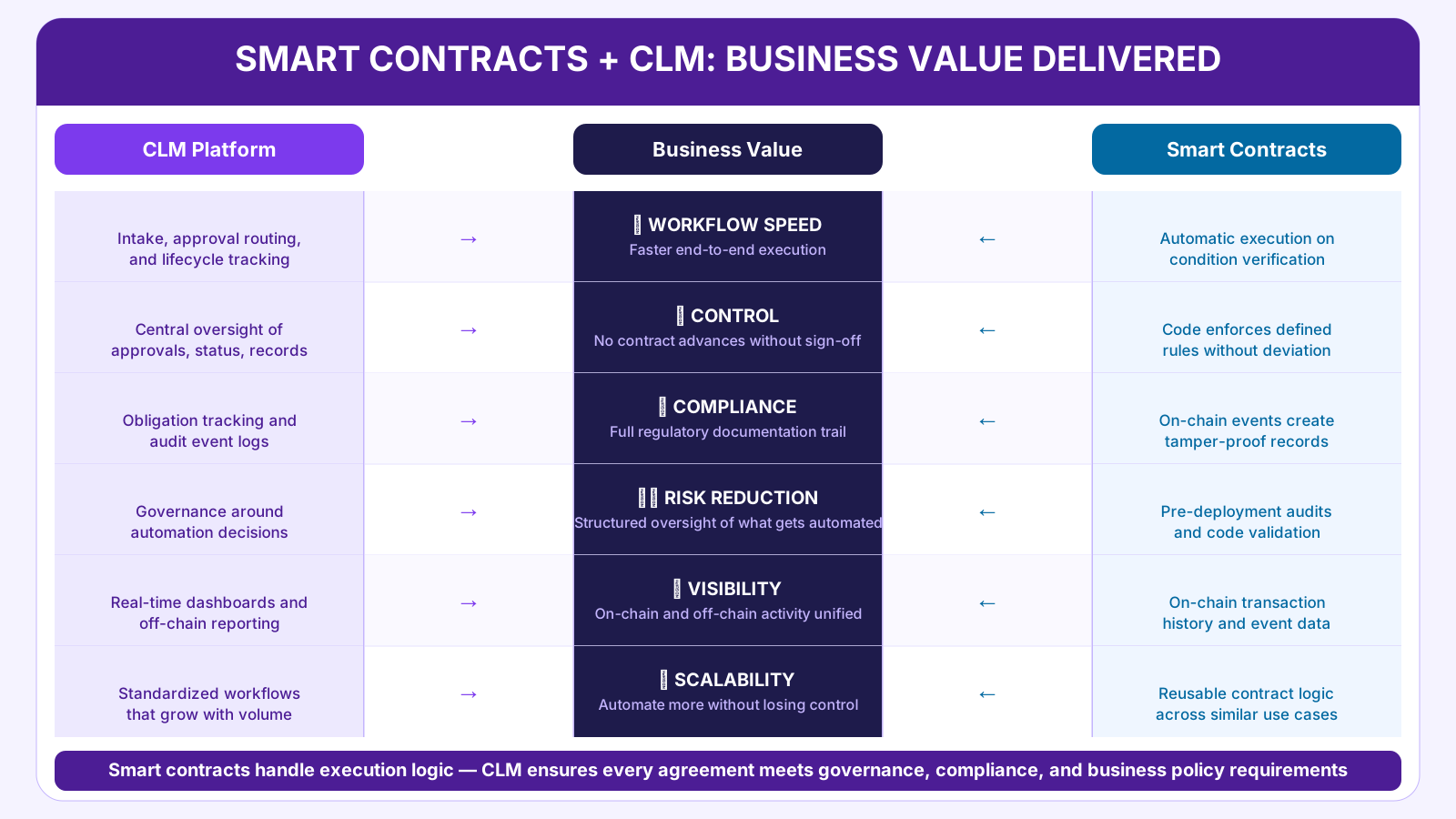
| Business area | Value delivered |
|---|---|
| Workflow speed | Faster execution of well-defined obligations |
| Control | Central oversight of approvals, status, and records |
| Compliance | Better tracking of obligations and audit events |
| Risk reduction | Structured governance around automation decisions |
| Visibility | Clear reporting across on-chain and off-chain activities |
| Scalability | Ability to automate selected processes without losing enterprise control |
CAMARC supports the enterprise side by centralizing requests, routing approvals, tracking obligations, and strengthening governance. If your team is managing contracts through email or shared folders, the first step is moving to a governed CLM model that establishes the visibility and control needed before adding automation layers.
References: CAMARC homepage, Benefits of Contract Lifecycle Management Software
If you want contract automation without losing oversight, request a demo from CAMARC and see how modern CLM supports controlled innovation across your contract operations.
FAQs
1. What is the main difference between smart contracts and traditional contracts?
Smart contracts are code-based and self-executing on blockchain platforms, while traditional contracts are text-based legal agreements enforced through legal systems and business processes.
2. Are smart contracts legally enforceable?
They may be recognized in some jurisdictions, but legal treatment is still evolving. Most businesses should not assume that code alone replaces a fully enforceable legal agreement. Legal counsel should review any smart contract deployment.
3. What are smart contracts used for?
They are commonly used for structured automation such as payments, settlement logic, supply chain workflows, insurance claim triggers, royalty distribution, and compliance checkpoints tied to verified data events.
4. Why is smart contract auditing important?
Smart contract auditing helps identify code flaws, security weaknesses, and execution risks before deployment. It is a key safeguard against smart contract vulnerabilities that can result in incorrect or irreversible transactions.
5. Are Ethereum smart contracts better than Bitcoin smart contracts?
Ethereum smart contracts are generally more flexible for broader automation scenarios. Bitcoin smart contracts exist in a more limited scripting form and are less adaptable for complex business logic or multi-step workflows.
6. Can smart contracts replace CLM software?
No. Smart contracts can automate execution logic for specific conditions, but CLM manages the full lifecycle: intake, approvals, repository, compliance, obligation tracking, and renewals. Both serve different and complementary functions.
Conclusion
Smart contracts and traditional contracts solve different problems. Smart contracts bring automation, speed, and consistency to highly structured workflows. Traditional contracts provide the flexibility, legal context, and interpretive depth that most business relationships still require.
For enterprises, the question is how to use each approach where it delivers value. That means choosing appropriate smart contract applications, auditing them rigorously, and managing them within a broader contract lifecycle framework that maintains governance and compliance visibility.
CAMARC supports that framework with workflow automation, contract visibility, and AI-driven risk controls — helping teams modernize contract operations without sacrificing governance or control.