Mining Contract Data for Business Insights
Educational note: This article is educational and strategic in nature. It should not be presented as legal advice.
Contracts do more than formalize an agreement. They capture pricing logic, service levels, renewal triggers, obligations, exceptions, risk language, and negotiation history that influence revenue, cost, and compliance every day.
The challenge is that most organizations still treat contracts as static files. They can find a document when needed, but they cannot easily turn it into business insights from contracts that help leaders reduce leakage, improve supplier outcomes, or act before risk becomes a problem.
This is where CLM analytics changes the conversation. With the right contract data management system, companies can convert every signed agreement into structured, searchable intelligence. In this blog, we explain how CAMARC helps teams use contract data analytics to uncover spend patterns, measure risk exposure, spot performance trends, and support decisions such as renegotiating clauses that repeatedly create friction.
For organizations managing hundreds or thousands of agreements, the shift is significant. Contracts stop being archived paperwork and become an operational dataset that supports forecasting, governance, and continuous improvement across the business.
Why contract data matters
Contracts sit at the center of procurement, sales, legal, finance, and operations. Yet the data inside them is often scattered across email threads, shared drives, and legacy systems. That fragmentation limits visibility and slows action.
When data is locked in unstructured documents, teams struggle to answer simple questions. Which suppliers account for the highest committed spend? Which clauses drive the most escalations? Which renewals expose the company to cost increases? Which business units miss obligations most often?
A modern contract data analysis software approach solves that problem by turning documents into connected records. Instead of opening files one by one, teams can review trends across thousands of agreements. This is the foundation of an effective contract intelligence platform.
CAMARC is designed for that shift. The platform centralizes request, review, approval, execution, tracking, and reporting in one workspace. It combines workflow control with dashboards, audit trails, and configurable rules so organizations can build a reliable source of truth for their contract portfolio.
The post-signature phase is where many organizations lose control. A contract may be signed on time, but obligations, notice periods, service levels, and renewal actions often remain disconnected from daily work. Without analytics, teams only discover problems after value has leaked or risk has materialized.
That matters because poor contracting is expensive. According to World Commerce & Contracting, the average organization loses almost 9 percent of value annually through poor contract management, and data is often spread across many disconnected systems. Better visibility is not just operational hygiene. It is a route to margin protection and faster decision-making.
In practical terms, contract visibility helps teams move from a reactive model to a managed one. Instead of asking what happened after a dispute, they can ask which warning signs tend to appear beforehand and where process changes would have the greatest impact.
- Centralization reduces time spent searching for documents and versions.
- Structured data makes contracts measurable, comparable, and reportable.
- Cross-functional visibility helps legal, procurement, finance, and operations work from the same facts.
- Traceability supports audit readiness and accountability across the lifecycle.
See how CAMARC centralizes contract records, workflows, and reporting in one controlled workspace. Request a tailored demo for your team.
Request a Tailored DemoReference: CAMARC Product Overview | WorldCC Contract Management Research
What CLM analytics should reveal
The purpose of contract analytics software is not to create more charts. It is to surface the information leaders need to make better commercial decisions. Strong contract lifecycle analytics should reveal at least four categories of insight.
First is spend analysis. By combining contract values, pricing schedules, amendments, and renewals, teams can identify concentration risk, off-contract spending, inconsistent rates, and contracts that should be consolidated. This is where contract reporting software and a clear contract analytics dashboard become especially valuable.
Second is risk exposure. Good ai contract analytics can flag clause deviations, missing protections, non-standard liability terms, weak termination language, or notice periods that create operational risk. A reliable view of risk is essential when contracts are spread across vendors, regions, and business units.
Third is performance. Contract performance analytics and contract performance reporting show whether obligations are being met, whether approvals are slowing deals, and whether suppliers or internal teams consistently miss deadlines. Looking at the portfolio over time helps leaders separate isolated issues from recurring patterns.
Fourth is negotiation intelligence. Repeated edits, redlines, and exception requests often reveal where standards are unrealistic, unclear, or outdated. If one indemnity clause delays every third-party negotiation, analytics can justify a playbook update or a more flexible fallback position. That is how contract data insights turn into process improvement.
Strong analytics also enables segmentation. Leaders can compare outcomes by supplier type, contract family, business unit, geography, or risk tier. That makes it easier to focus resources where the return is highest rather than applying the same review effort to every agreement.
Trend analysis matters as much as point-in-time reporting. A single high-risk clause may not justify immediate redesign, but a six-month pattern of repeat escalations, longer cycle times, and post-signature issues usually does. This is where analytics becomes a management tool rather than a reporting exercise.
Scenario planning is another benefit. If upcoming renewals cluster in one category, leaders can anticipate negotiation workload, estimate budget exposure, and decide whether a broader sourcing event or policy change is needed. That kind of forward view is one of the clearest signs that a contract analytics software program is creating value.
- Spend visibility: committed value, category trends, expiring commercial terms, and consolidation opportunities.
- Risk visibility: non-standard clauses, missing approvals, untracked obligations, and high-exposure vendors.
- Performance visibility: cycle time, renewal timeliness, obligation completion, and dispute patterns.
- Negotiation visibility: frequent redlines, commonly rejected clauses, and bottlenecks by counterparty or team.
Want a clearer view of spend, risk, and obligation trends? Ask for a CAMARC analytics walkthrough built around your contract portfolio.
Ask for an Analytics Walkthrough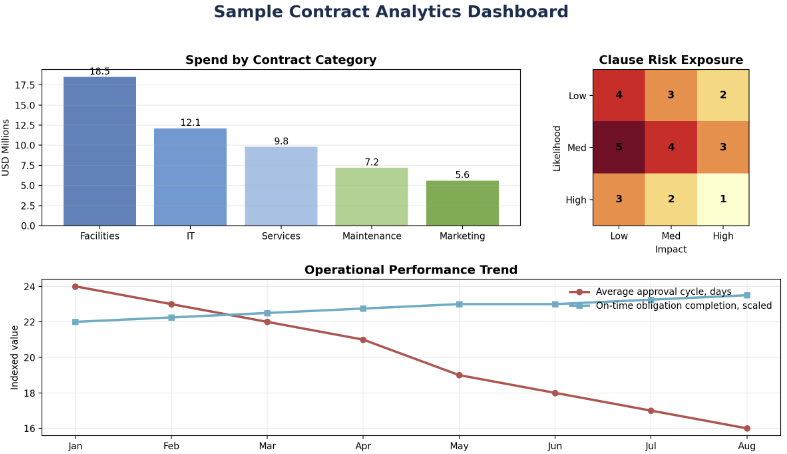
Reference: CAMARC AI in Contract Management | McKinsey on data and AI in procurement | NIST Risk Management
How CAMARC turns documents into intelligence
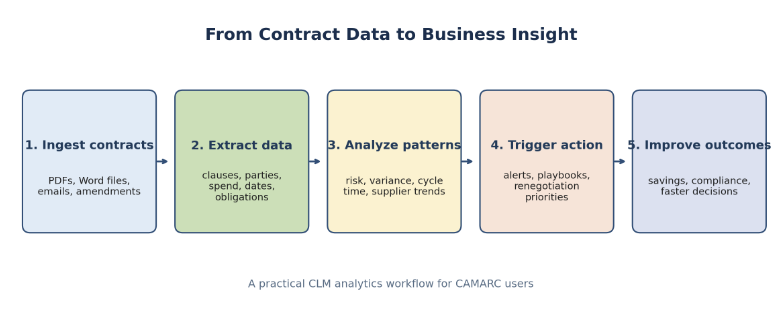
Actionable analytics start with trusted data. CAMARC supports that by bringing intake, collaboration, approvals, execution, obligation tracking, and dashboard reporting into one controlled environment. The goal is simple: make sure the information captured during the contract lifecycle becomes usable after signature as well.
The first step is contract data extraction. Key fields such as party names, dates, values, categories, notice periods, renewal terms, and clause indicators need to be identified and structured consistently. This is where contract intelligence software and contract data intelligence become practical, not theoretical. If extraction is inconsistent, analytics will also be inconsistent.
The second step is normalization. Similar clauses must be grouped, supplier names standardized, metadata validated, and exceptions tagged. Reliable contract data extraction is important, but reliable organization is just as important if teams want meaningful comparisons across the portfolio.
The third step is analysis and monitoring. CAMARC combines workflow data with contract content to support contract lifecycle analytics across status, approvals, obligations, deadlines, and performance metrics. Dashboards can help teams track cycle time, pending approvals, high-risk provisions, expiring agreements, and workload distribution.
The final step is action. A good contract data management system does not stop at visibility. It supports alerts, escalation, task ownership, and reporting so teams can intervene early. If a vendor group has repeated SLA failures or a clause family is linked to recurring disputes, CAMARC helps teams identify that pattern and move from reporting to remediation.
Data governance is a critical part of this model. If templates are inconsistent, amendments are not linked properly, or metadata is optional, dashboards lose trust quickly. CAMARC helps teams create repeatable capture rules so the portfolio becomes more reliable over time, not less.
This matters because analytics maturity is cumulative. The better the quality of intake, clause tagging, obligation ownership, and approval history, the stronger the resulting contract data intelligence. That creates a feedback loop where every contract improves the value of the next report.
This combination of workflow control and contract data intelligence is what makes CAMARC more than document storage. It acts as a practical contract intelligence platform for organizations that want their contract repository to drive operational improvement.
- Capture the right data at request, review, and execution stages.
- Standardize metadata so reports compare like with like.
- Monitor obligations and deadlines in one place.
- Use dashboards and alerts to focus attention on high-impact issues first.
Explore how CAMARC transforms contract documents into structured, searchable intelligence with dashboards, alerts, and audit-ready visibility.
Explore the Product OverviewReference: CAMARC How It Works | CAMARC About | CAMARC Contract Data Accuracy Article
How insights shape strategic action
Analytics becomes valuable when it informs a specific decision. For procurement teams, that could mean renegotiating pricing terms where spend analysis shows unnecessary variance across similar suppliers. For legal teams, it could mean revising fallback language when a clause repeatedly slows approvals or creates disputes. For operations teams, it could mean assigning clearer owners for obligations that are often missed.
Consider a common scenario. A portfolio review shows that three non-standard limitation-of-liability variations appear in most escalated vendor deals. At the same time, those deals have longer approval times and higher rates of post-signature issue management. That pattern suggests the organization should revisit its standard language, define pre-approved alternatives, and train negotiators to use them consistently.
A similar approach works for renewals. If contract performance analytics shows that contracts with auto-renewal terms and weak notice tracking drive avoidable spend, leaders can implement earlier alerts, stronger review rules, and a standard pre-renewal checklist. This is where business insights from contracts move directly into savings and risk reduction.
Over time, portfolio-level insight supports better forecasting too. Teams can estimate future renewal exposure, identify categories likely to require renegotiation, and prioritize suppliers that need a service-level review. When paired with operational metrics, contract analytics software gives leaders a clearer picture of both current risk and future workload.
The same logic applies to internal process design. If approval times are consistently longer for certain contract families, the issue may not be legal complexity alone. It may point to missing intake data, unclear ownership, or approval rules that no longer match the business. Analytics helps teams fix the process behind the delay.
Executive reviews become stronger when they are evidence-based. Instead of generic updates, teams can show where the portfolio is improving, where exceptions are accumulating, and which actions are producing measurable gains. That improves accountability and creates momentum for continuous refinement.
The most important point is this: analytics should change behavior. It should influence playbooks, approvals, fallback terms, vendor strategy, and governance. That is the difference between passive reporting and active contract intelligence.
- Renegotiate frequently problematic clauses using evidence from exception and dispute trends.
- Prioritize renewals by spend, risk, and supplier performance.
- Improve playbooks when analytics shows repeated delays or avoidable redlines.
- Focus leadership attention on the small set of contracts with the highest business impact.
Use CAMARC to turn insight into action, from clause renegotiation and renewal planning to supplier reviews and governance improvements.
Talk to the CAMARC TeamReference: CAMARC Contract Management Articles | CAMARC Contract Lifecycle Guide | McKinsey procurement analytics article
Business value for decision makers
For senior leaders, the value of clm analytics is not technical. It is practical. Better analytics helps the business protect margin, reduce delays, improve compliance, and make decisions with more confidence.
A CFO gains clearer visibility into committed spend, renewal exposure, and leakage risk. A General Counsel gains a better view of clause deviations, auditability, and policy compliance. A procurement leader gains evidence for supplier consolidation and renegotiation. An operations leader gains clearer ownership of deadlines, approvals, and obligations.
CAMARC supports that value by combining a controlled workflow with contract reporting software, dashboard visibility, and structured contract records. It helps decision makers move from reactive firefighting to proactive portfolio management.
This value often appears in small but meaningful wins at first: fewer missed renewals, faster turnarounds for standard contracts, clearer accountability for obligations, and quicker identification of non-standard risk. Over time, those gains compound into stronger governance and more predictable commercial outcomes.
In simple terms, this means fewer surprises, faster approvals, stronger governance, and more reliable execution. That is what growth-oriented teams need when contract volumes rise and risk becomes harder to monitor manually.
For teams under pressure to scale without adding headcount at the same rate, that operational leverage is especially important. A better contract data management system gives leaders more visibility and control without forcing them into more manual review work.
- For finance: better spend control and renewal forecasting.
- For legal: stronger compliance and clause consistency.
- For procurement: clearer supplier leverage and performance trends.
- For operations: better accountability across approvals and obligations.
Reference: CAMARC Product Overview | CAMARC About
Frequently Asked Questions
What is contract analytics?
Contract analytics is the process of turning contract language, metadata, workflow history, and obligation tracking into usable insight. It helps organizations understand spend, risk, performance, and exceptions across their contract portfolio instead of reviewing each agreement manually. In practice, it gives leaders a faster way to decide where to intervene and what to improve.
How does CLM analytics help procurement teams?
CLM analytics helps procurement teams see committed spend, supplier concentration, renewal exposure, pricing variance, and performance issues. That visibility supports better sourcing decisions, stronger negotiations, and more proactive supplier management. It also helps procurement prioritize which suppliers and renewals deserve attention first.
What is the difference between contract storage and contract intelligence software?
Basic storage helps teams save and retrieve files. Contract intelligence software goes further by extracting key data, standardizing metadata, monitoring obligations, and surfacing trends that support decision-making across legal, finance, procurement, and operations. The difference is not where the contract sits, but what the business can learn and do because of it.
Why is contract data extraction important for reporting?
Reporting depends on accurate data. Without reliable contract data extraction, dashboards may miss key dates, obligations, clause deviations, or spend details. Structured data is what makes contract reporting software and contract performance reporting trustworthy. If the source data is weak, the reporting will be weak too.
Can AI contract analytics replace human review?
No. AI contract analytics can accelerate review, highlight anomalies, and support prioritization, but people still define standards, validate risk, and decide strategy. The best results come from combining automation with clear governance and expert judgment. AI improves scale and speed, while human review protects context and accountability.
What should companies measure first?
Start with the metrics that influence business outcomes most directly: cycle time, renewal exposure, high-risk clause use, obligation completion, and category spend. Those measures usually create the fastest path from contract data to action. Once those signals are stable, teams can add deeper metrics such as clause-level deviation trends and business-unit benchmarking.
Conclusion and calls to action
Contracts contain a rich layer of operational and commercial intelligence, but only if that information is captured, structured, and analyzed in context. With the right contract analytics dashboard, organizations can move beyond document storage and use contracts as a decision asset.
CAMARC brings together workflow automation, visibility, contract data analytics, and action-oriented monitoring so teams can uncover savings, reduce risk, and improve performance with confidence. In a market where every renewal, clause, and obligation can affect margin, that capability is no longer optional.
The organizations that gain the most from analytics are not necessarily the ones with the most contracts. They are the ones that use insight to simplify decisions, strengthen governance, and continuously improve how agreements are created, negotiated, and managed.
Next steps with CAMARC
- Book a CAMARC demo: See how a modern contract data management system turns contracts into measurable business value. Open link →
- Ask for a portfolio review workshop: Identify where contract data insights can improve renewals, risk control, and supplier performance. Open link →
- Explore CAMARC dashboards: Get clearer visibility into contract performance analytics, obligations, approvals, and deadlines. Open link →
- Talk to the CAMARC team: Build a scalable contract intelligence platform that supports better commercial decisions across the lifecycle. Open link →
Turn Contract Data Into Business Insight
See how CAMARC combines workflow control, structured contract records, dashboards, and alerts so teams can act earlier and decide with more confidence.
Book a Demo